
How Long Does Professional Furniture Assembly Take?
If you’ve ever stared at a flat-pack box and wondered how long professional furniture assembly actually takes, you’re not alone. As a Brampton handyman who’s assembled hundreds of IKEA beds, dressers, wardrobes, and more, I can tell you the answer isn’t as simple as the manufacturer’s “estimated time” on the box. In this post, I’ll break down realistic assembly times based on my experience, share a real case study where things took longer than expected, and give you my go-to formula for estimating jobs so you know exactly what to expect when hiring a pro.
My Most Common Job: IKEA Queen Bed Assembly
From my experience as a Brampton handyman, the most common furniture assembly job I get is an IKEA queen bed frame, especially models with slats and a headboard. For a straightforward IKEA queen bed, I usually budget about 1.5 to 2 hours from unboxing to cleanup. That includes opening and organizing the hardware, checking the instructions, assembling the frame and slats, tightening and leveling everything, and cleaning up all the cardboard and packaging afterward.
The assembly itself usually isn’t the hardest part. What takes time is making sure everything is square and properly tightened. I’ve seen homeowners rush through that part and end up with a bed that squeaks, rocks, or has uneven gaps. I also find that the advertised assembly time can be misleading because every job is a little different. Missing hardware, damaged parts, unclear instructions, or a tight room can easily add another 30 minutes or more.
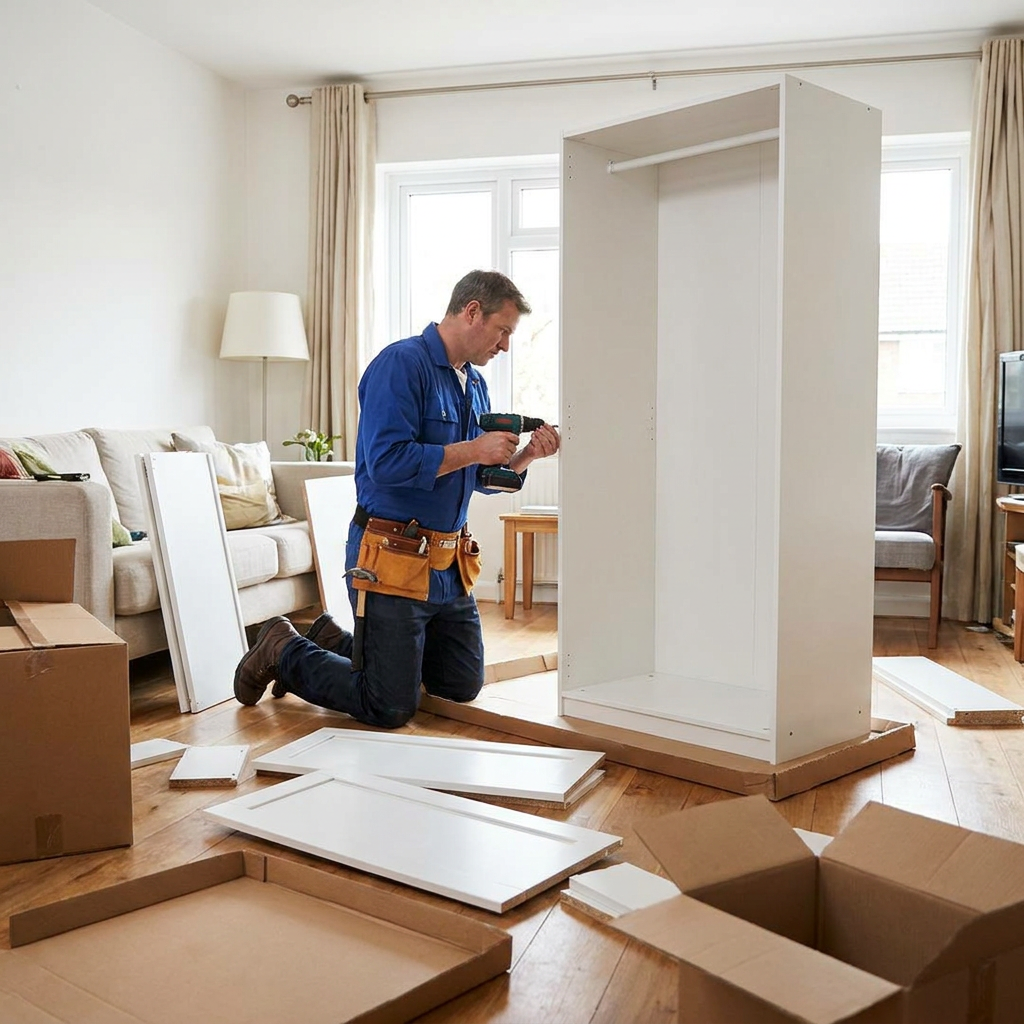
A Real Case Study: When a 2-Hour Job Became 3 Hours
A good example was an IKEA queen bed assembly in a Brampton townhouse where I expected the job to take around two hours, but it ended up taking closer to three hours. The main issue was the bedroom was quite tight, so I couldn’t lay all the bed components out and assemble them in the normal order. I had to build sections individually and work around the walls and existing furniture.
There was also a problem with one of the pieces not lining up properly. Rather than forcing the hardware and potentially damaging the frame, I took the time to double-check the orientation and instructions. Once I realized one of the pieces had been positioned incorrectly, I was able to correct it and continue.
The customer also wanted the bed positioned precisely against the wall and asked me to make sure it was completely solid and level before I left. That added some time, but it was worthwhile. That job is a good example of why I don’t give homeowners an exact assembly time based only on the furniture itself. A bed that normally takes 1.5–2 hours can easily become a three-hour job when you add a tight workspace, alignment issues, and extra care to make sure everything is properly assembled. As a handyman, I’d rather take the extra time than rush through it and leave the customer with a bed that squeaks, wobbles, or needs to be taken apart and fixed later.
Assembly Times by Furniture Type: What to Expect
From my experience as a Brampton handyman, after IKEA beds, desks, dressers, TV stands, bookshelves, and wardrobes are some of the most common furniture assembly jobs I get. Outdoor furniture is also popular during the warmer months. Typical times vary quite a bit depending on the number of parts and how complicated the instructions are:
- Desks: Usually 1–2 hours. Basic writing desks can be quick, but desks with drawers, cabinets, or cable-management systems take longer.
- Dressers: Usually 1.5–3 hours. The drawers are what tend to add time, especially when there are six or eight of them.
- TV stands: Around 1–2 hours. They can look simple, but there are often a surprising number of small pieces and hardware.
- Bookshelves: Usually 45 minutes to 1.5 hours. Basic shelves are relatively straightforward, although larger units take longer to level and secure properly.
- Wardrobes: Often 2–4 hours. These can be much more involved because of the size, doors, shelves, drawers, and alignment.
- Outdoor furniture: Usually 1–3 hours depending on whether it’s a small patio set or something larger like a gazebo, sectional, or storage unit.
The pieces that consistently surprise homeowners are dressers and wardrobes. They look straightforward when they’re sitting in the box, but once you have dozens of panels, drawer components, hinges, and fasteners spread across the floor, the time adds up quickly. I’ve also had the opposite happen with some IKEA bookshelves and simple desks. Once everything is organized and the instructions are clear, they can go together much faster than homeowners expect. My biggest advice is don’t judge an assembly job by the size of the finished furniture. A small dresser with eight drawers can take longer than a much larger bookshelf. I estimate the job based on the number of components, drawers and doors, hardware, and how much precision is required—not simply how big the furniture looks.
Top 5 Factors That Slow Down Furniture Assembly
From my experience as a Brampton handyman, there are a few things that consistently turn a straightforward furniture assembly into a longer job. The biggest ones are:
- Missing or incorrect hardware. This is probably the most frustrating delay. If a bolt, screw, bracket, or connector is missing, I may have to stop the assembly while the customer contacts the manufacturer or find a suitable replacement. I always recommend opening the box and checking the hardware before the appointment.
- Damaged or defective parts. Occasionally, a panel is cracked, warped, scratched, or has a pre-drilled hole in the wrong location. You can’t always see these problems until you’re partway through the assembly. My advice is to inspect the panels as soon as the furniture is unpacked and take photos of anything damaged before throwing away the packaging.
- Limited workspace. This is very common in Brampton townhouses and condos. A wardrobe or large bed can be difficult to assemble when you’re working in a small bedroom with other furniture already in place. If possible, I recommend clearing enough floor space to lay out the major pieces before I arrive.
- Complicated instructions or too many small components. Some furniture looks simple but has dozens of panels and hardware pieces. I don’t like rushing these jobs because installing one panel backwards can mean taking half the furniture apart to correct it. Keeping the instructions and all hardware together makes a big difference.
- Changes during the assembly. Sometimes a customer decides they want the desk facing a different direction, moves the bed to another wall, or wants shelves or doors configured differently after we’ve started. Those changes can require partially disassembling what has already been built.
The biggest thing I tell clients beforehand is don’t throw anything away until the furniture is completely assembled and checked. Keep the instructions, hardware, packaging, and spare parts nearby until we’re finished. I also recommend clearing the assembly area before the appointment and checking the box for obvious damage or missing pieces. Those two simple steps can save a surprising amount of time. And from my perspective, I’d rather spend an extra 15 minutes organizing the parts and reading the instructions than rush into assembly. Good preparation almost always makes the actual assembly faster and prevents mistakes that can cost much more time to fix later.
My Go-To Formula for Giving Time Estimates
From my experience as a Brampton handyman, I don’t rely too heavily on the manufacturer’s advertised assembly time. I use a quick mental checklist based on what actually has to be assembled. My rule of thumb is to look at the number of drawers, doors, shelves, panels, and moving parts. A basic desk with four or five major pieces might be a 1–1.5 hour job, while a dresser with eight drawers could easily be 2–3 hours. I also add some buffer for unpacking, organizing hardware, reading the instructions, and cleanup.
When giving an estimate over the phone or text, I usually give a range rather than promising an exact number. For example, I might tell a customer, “I’d estimate about two hours, but I’d allow 1.5–2.5 hours depending on the model, the number of pieces, and whether there are any issues with the hardware or parts.” I also ask customers to send me a photo or link to the exact furniture model whenever possible. That makes a huge difference because two pieces of furniture that look similar in a photo can have completely different assembly requirements.
The other thing I make clear is that my estimate includes the whole job—not just turning the screws. I’m allowing time for unboxing, sorting parts, assembling everything correctly, checking that doors and drawers operate properly, leveling or adjusting the furniture where necessary, and cleaning up the packaging. I’d rather give a realistic range upfront than tell someone, “It will take exactly two hours,” and then have the customer surprised when the job takes longer. In my experience, a little extra time built into the estimate is much better than rushing an assembly just to hit an arbitrary number.
Final Thoughts: Why Realistic Timing Matters
Professional furniture assembly isn’t just about speed—it’s about precision, care, and leaving you with furniture that’s built to last. Whether it’s an IKEA bed, a dresser with eight drawers, or a full wardrobe, the time it takes depends on the complexity of the piece, the workspace, and a few other factors that only an experienced handyman can anticipate. By understanding what goes into a proper assembly job and setting realistic expectations upfront, you’ll avoid surprises and end up with furniture that’s solid, level, and ready to use for years to come.
Contact us today to discuss your furniture assembly needs and get a free quote