
What’s the Difference Between K-Style and Half-Round Gutters?
If you’re a homeowner in Brampton or across Southern Ontario trying to choose between K-style and half-round gutters, you’ve probably read a dozen generic articles that list pros and cons but don’t help you decide what’s right for your actual house. As a local handyman who’s installed, repaired, and replaced gutters on everything from new subdivision builds to older character homes, I can tell you this: the “best” gutter isn’t about the shape, it’s about how well the whole system is designed and installed for your home.
That said, there are real differences between K-style and half-round gutters, and those differences matter depending on your home’s age, architecture, drainage needs, and budget. Here’s what I’ve learned from working on homes across Brampton and the region.
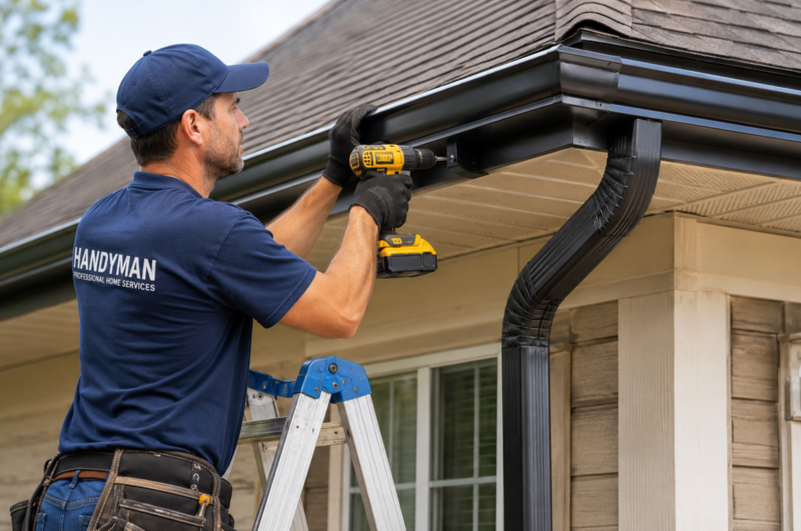
K-Style vs. Half-Round: What I See on Brampton Homes
In my experience, K-style gutters are by far the most common on residential homes in Brampton and newer Southern Ontario subdivisions. If you drive through a typical neighborhood built from the 1980s onward, you’ll see K-style on the vast majority of detached homes, semis, and townhouses. They’re practical, widely available, and match the clean, straight lines of modern suburban architecture.
Half-round gutters show up much less often, and when they do, it’s usually on older homes, character properties, or houses with traditional or heritage-style details. Their rounded profile gives a softer, more decorative look that complements older rooflines, wood trim, and period architecture. I also see homeowners choose half-round as an intentional upgrade when they’re restoring or enhancing a home’s original character.
Neighborhood age makes a noticeable difference. In established older areas of Brampton, I’m more likely to encounter half-round or other older-style systems, though many of these homes have been updated to K-style over the years. In newer subdivisions, K-style is essentially the standard.
What Homeowners Ask Me Most (and What They Get Wrong)
When homeowners in Brampton ask me whether to go with K-style or half-round, the conversation almost always comes down to three concerns: cost, maintenance, and appearance.
Cost and Value for Money
This is almost always the first question: “How much more does one type cost than the other?” In most cases, K-style gutters are the more affordable and widely available option. There are more contractors who install them, replacement parts are easy to find, and they fit the majority of homes in Brampton.
Half-round gutters often cost more because the materials, brackets, corners, and accessories can be more specialized. Installation can also take longer depending on the home. What homeowners sometimes misunderstand is that the “cheapest” option is not always the best value. A properly sized, well-installed gutter system that drains correctly will save far more money over time than choosing a lower-cost system that overflows or causes water problems around the foundation.
Clogging and Ease of Cleaning
The second question I hear a lot is: “Which type clogs less?” There is some truth to the idea that half-round gutters can shed debris a little more easily because they have a smooth curved bottom and fewer internal corners where leaves and dirt collect.
However, this is one of the biggest misconceptions homeowners have. In Southern Ontario, gutter performance is affected far more by:
- Proper sizing
- Correct slope and installation
- Adequate downspout placement
- Nearby trees
- Regular cleaning and maintenance
I have seen perfectly good K-style gutters fail because they were installed with poor pitch, and I have seen half-round systems clog because they were never maintained. The shape of the gutter matters, but installation quality matters much more.
Appearance and Curb Appeal
Appearance is especially important for homeowners with older homes, custom builds, or high-end renovations. K-style gutters have a modern look and blend into most suburban homes, while half-round gutters offer a softer, more traditional appearance that suits heritage or architectural styles.
A common misunderstanding is that half-round gutters are always just a decorative upgrade. In reality, they can perform very well when properly sized, but homeowners should choose them primarily because they fit the style of the home, not because they expect dramatically better performance.
If I had to point to one thing homeowners get wrong most often, it would be this: people tend to focus on gutter shape when they should be focusing on system design and installation quality. In Brampton’s climate, with heavy spring rains, summer storms, falling leaves, and freeze-thaw cycles, a correctly pitched, securely fastened gutter system with properly placed downspouts is usually more important than whether the gutter is K-style or half-round.
A Real Brampton Case Study: When Half-Round Made Sense
One example that stands out involved an older detached home in Brampton where the homeowner was replacing an aging gutter system during a larger exterior renovation. The house had a traditional architectural style, a relatively steep roof, and older fascia details. The existing gutters had developed several problems, including overflowing during heavy rain and water collecting near one section of the foundation.
The homeowner initially wanted standard K-style gutters because they were familiar with them and expected them to be the most practical option. After looking at the home’s architecture and drainage layout, I recommended half-round gutters instead. The goal wasn’t simply to make the house look different. The rounded profile suited the older character of the property much better, and we could design the replacement system around the actual roof drainage requirements rather than simply copying the existing installation.
Before installing anything, we addressed the underlying drainage issues, checked the fascia, corrected the gutter slope, and made sure the downspouts were positioned to move water away from the foundation. I also explained that the gutter profile itself wasn’t going to solve the overflowing problem, the system needed to be correctly sized and installed.
The finished half-round system gave the home a noticeably cleaner, more traditional appearance, and the homeowner was particularly happy that the new gutters looked like they belonged with the house rather than looking like an afterthought. More importantly, the drainage improved significantly during subsequent heavy rainfall, with much less water spilling over the edges.
The lesson I took from that project is that I wouldn’t recommend half-round simply because it is considered a premium product, or K-style simply because it is more common. I look at the age and style of the home, roof configuration, drainage requirements, fascia condition, budget, and the homeowner’s priorities. For a typical newer Brampton subdivision home, K-style would usually be my practical recommendation. For an older or character home where appearance matters, half-round can be an excellent choice when the system is properly designed and installed.
Installation and Maintenance: What’s Different in the Field
From a practical handyman standpoint, I notice three main differences when installing and maintaining K-style versus half-round gutters in Brampton and Southern Ontario.
Easier Fabrication and Availability with K-Style
K-style gutters are extremely common, so the materials, corners, end caps, hangers, and downspout fittings are readily available. They are relatively straightforward to cut, join, and install on a typical Brampton home. Half-round systems can require more specialized brackets and fittings, and getting clean, properly sealed joints can take a little more care. The installation method also depends more heavily on the specific half-round system being used.
Different Fastening and Support Systems
K-style gutters are commonly supported with hidden hangers or fascia-mounted brackets, while half-round gutters often use more visible brackets or hangers that support the rounded shape from underneath. With either system, I pay close attention to spacing and attachment points because Southern Ontario winters bring snow, ice, and freeze-thaw cycles. A gutter can be perfectly good but still fail if it isn’t securely fastened to sound fascia.
Gutter Guards and Maintenance Considerations
K-style has a huge range of gutter guards available, so finding a compatible product is usually straightforward. Half-round can have fewer options depending on the exact profile, so I always check compatibility rather than assuming a standard guard will fit. As for clogging, I wouldn’t automatically say one style is maintenance-free. Trees, roof debris, guard quality, downspout size, and cleaning frequency are usually much bigger factors.
One common failure I see isn’t really caused by the gutter shape at all. It’s poor installation, insufficient slope, loose fasteners, undersized downspouts, bad joints, or deteriorated fascia. In Brampton’s climate, those issues become especially noticeable when heavy rain is followed by snow, ice, and repeated freeze-thaw cycles.
My practical rule is to choose the gutter style that suits the house, but put even more emphasis on proper sizing, secure fastening, correct slope, good-quality joints, and adequate downspouts. A well-installed K-style system will outperform a poorly installed half-round system every time.
My No-BS Recommendation for Brampton Homeowners
If you’re reading this and trying to decide between K-style and half-round gutters, here’s my simple, no-nonsense recommendation framework:
- First: Prioritize drainage and performance. Before worrying about appearance, make sure the gutter system is properly sized for the roof, has enough downspouts, has the correct slope, and can move water safely away from the foundation. I would also check the fascia and roofline because there’s no point installing beautiful new gutters on rotten or poorly supported material. A gutter’s shape won’t compensate for a poorly designed drainage system.
- Second: Match the gutter to the home. For the typical newer Brampton detached, semi-detached, or townhouse, K-style is usually my first choice. It’s practical, widely available, easy to repair, and generally more economical. For an older character home, heritage-style property, or a house with traditional architectural details, half-round is worth considering because its rounded profile can look much more natural.
- Third: Consider budget and long-term maintenance. If two systems will perform equally well on the house, I’d usually recommend K-style if keeping costs reasonable is the priority. If the homeowner cares strongly about appearance and is comfortable paying more for specialized materials and installation, half-round can be a worthwhile upgrade.
So my quick decision rule would be:
- Typical newer Brampton home → K-style
- Older, traditional, or character home → consider half-round
- Custom/high-end renovation → compare both based on architecture, drainage requirements, and budget
- Heavy tree coverage → prioritize maintenance and guard compatibility regardless of gutter style
And the most important point: don’t make the gutter shape your first decision. My priorities would be 1) drainage and installation quality, 2) compatibility with the home’s architecture, and 3) cost and maintenance. If a contractor spends more time talking about the shape and colour than about roof drainage, downspouts, fascia condition, slope, and fastening, I’d ask more questions before signing the quote.
Final Thoughts
Choosing between K-style and half-round gutters isn’t about picking the “better” shape, it’s about picking the right system for your home. In Brampton and across Southern Ontario, that means thinking first about how water moves off your roof, how your gutters are supported, and how well the whole system handles our climate.
For most homeowners in newer subdivisions, K-style is the practical, cost-effective choice. For those with older or character homes, half-round can be a great way to enhance curb appeal while still delivering solid performance, if it’s installed correctly.
If you’re unsure which option makes sense for your property, start by talking to a local handyman or gutter specialist who can assess your roof, fascia, and drainage needs before recommending a style. The right gutter system isn’t just about looks, it’s about protecting your home for years to come.