
Where Should Weather Stripping Be Installed in Your Home?
Weather stripping is installed around movable parts of your home’s exterior openings, especially doors and operable windows. Its job is to close the small gaps that allow outdoor air, dust, moisture, and noise to enter while helping your heating and cooling system maintain a more consistent indoor temperature.
As a Brampton handyman, I have worked on older detached homes, newer subdivisions, townhomes, condos, rental properties, and small commercial buildings. Although each property has different construction details, the most common weather-stripping locations are exterior doors, windows, patio doors, and other openings where one movable surface must seal against another.
However, not every gap requires weather stripping. Weather stripping is generally used around moving components. Stationary gaps around frames, trim, baseboards, or penetrations usually need caulking or another suitable air-sealing material. Identifying the correct location and repair method is the key to achieving a durable result.
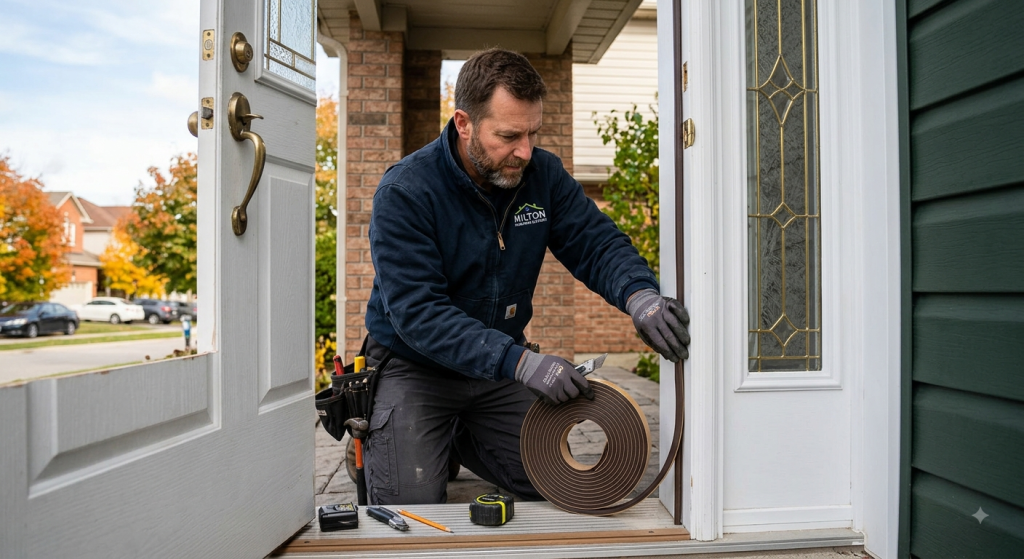
Common Places to Install Weather Stripping
Exterior Doors
Exterior doors are one of the first places I check when a homeowner complains about a draft. Weather stripping may be installed along the sides and top of the door frame, where the closed door presses against the seal.
The bottom of the door is another important area. Depending on the design, the repair may involve a door sweep, bottom seal, threshold adjustment, or a combination of components. The goal is to create continuous contact without making the door difficult to open and close.
Check weather stripping around:
- Front doors.
- Back and side entrances.
- Basement doors.
- Garage-to-house doors.
- Secondary exterior entrances.
- Doors leading to unheated areas.
Garage-to-house doors deserve particular attention because they separate the living area from a space that may be much colder in winter. The door should close properly and seal consistently around its entire perimeter.
Patio and Sliding Doors
Patio doors often develop air leaks as seals deteriorate, tracks become dirty, rollers wear out, or the door shifts out of alignment. Sliding doors can be more challenging than hinged doors because the sealing components must work while the door moves along its track.
When inspecting a patio door, I check the complete perimeter rather than focusing only on the area where the homeowner feels a draft. I also look for worn seals, gaps at the corners, damaged components, and movement that prevents consistent contact.
In one Brampton townhome, the homeowner noticed cold air around the patio door and increased outside noise. The existing seal had deteriorated in several areas, leaving small gaps around the perimeter. I replaced the damaged sealing components and sealed the appropriate stationary gaps around the frame. The homeowner later reported that the patio-door area felt noticeably less drafty and that outside noise had decreased.
Operable Windows
Weather stripping can be used around windows that open and close, including casement, awning, sliding, and hung windows. The exact product depends on the window design and how the movable sash meets the frame.
During an inspection, I look for:
- Compressed or flattened seals.
- Cracked or missing weather stripping.
- Gaps where the sash meets the frame.
- Loose or deteriorated caulking.
- Windows that do not close evenly.
- Drafts near the corners or locking points.
A window may have more than one source of air leakage. Replacing the movable seal may help, but stationary gaps around the frame may require an appropriate caulk or sealant instead. Applying weather stripping to the wrong surface can interfere with operation or fail to address the real problem.
Attic Access Doors and Hatches
Attic access points are frequently overlooked. An attic hatch may appear closed while still allowing warm indoor air to escape into the attic during winter.
Weather stripping can be installed around the movable edge of an attic access door or hatch when there is a suitable contact surface. The hatch should also sit tightly in its frame and remain properly positioned when closed.
Because warm air leakage into an attic can contribute to condensation and moisture problems, I recommend inspecting the hatch along with the surrounding frame and insulation. The correct repair may involve weather stripping, insulation, or sealing stationary gaps, depending on the construction.
Entry Doors in Condos and Rental Properties
In condos and rental properties, entry doors can allow drafts through the sides, top, or bottom. These doors may also transmit hallway noise if the perimeter seal is damaged or compressed.
For these openings, weather stripping must be compatible with the door and frame and should not prevent the door from latching correctly. In some buildings, repairs may need to follow condominium, landlord, or property-management requirements, particularly if the door is part of a shared building envelope or fire-separation assembly.
Small Commercial Exterior Doors
Small commercial buildings often have frequently used entry doors that experience more wear than residential doors. Repeated opening and closing can compress seals, loosen hardware, and affect alignment.
When a commercial door no longer makes even contact with its frame, replacing the weather stripping alone may not provide a lasting solution. The hinges, closer, frame, threshold, and surrounding seal may also need to be inspected.
Where Weather Stripping Should Not Be Used
One of the most important distinctions is between movable and stationary gaps.
Weather stripping is normally intended for locations where a door or window moves and must press against a flexible seal. Stationary gaps require a different material and repair method.
Stationary Gaps Around Frames and Trim
Gaps around window frames, door trim, baseboards, and exterior joints usually need an appropriate caulk or sealant. These areas do not move in the same way as a door or window, so adhesive-backed weather stripping may peel away or create an unattractive, unreliable repair.
I often find small gaps around door trim that contribute to drafts even after the main door seal has been replaced. These gaps should be cleaned, prepared, and sealed with a product suitable for the location and exposure.
Plumbing and Electrical Penetrations
Where pipes, wires, or other services pass through walls, air may move through small openings around the penetration. These areas are not generally repaired with standard weather stripping.
The appropriate material depends on the size of the opening, the surrounding surface, moisture exposure, and the type of service passing through it. In some situations, the repair may involve caulk, sealant, foam, or another suitable air-sealing material.
Baseboards and Wall Transitions
Air movement around baseboards or where different building materials meet can be difficult to notice. In older Brampton homes, walls, trim, and framing can shift over time, creating small gaps.
These areas may require a careful inspection rather than simply adding a strip of seal material. If the gap is caused by movement, moisture, or damaged material, the underlying issue should be considered before completing the repair.
Signs Your Home May Need Air Sealing
A noticeable draft is the most obvious warning sign, particularly around exterior doors, windows, and patio doors. However, air leakage can also create less obvious comfort and efficiency problems.
Common signs include:
- Cold air entering during winter.
- Warm air entering during summer.
- One room feeling consistently colder or warmer.
- A heating or cooling system running more frequently.
- Higher-than-expected energy bills.
- Visible gaps or cracked caulking.
- Compressed, loose, or damaged weather stripping.
- Temperature changes near windows or doors.
- Increased outside noise.
- Dust entering around openings.
- Condensation around windows.
Condensation can sometimes be related to air leakage, but it is not always caused by a failed seal. Indoor humidity, ventilation, window condition, and outdoor temperature should also be considered.
When several warning signs appear together, I recommend finding the source of the air movement before applying a new product. A visible gap is not necessarily the only place where air is entering.
How I Find the Source of an Air Leak
I start with a visual and hands-on inspection rather than immediately replacing weather stripping. I examine the opening, surrounding trim, frame, and nearby transitions to determine how the components are interacting.
Visual and Hands-On Inspection
I check for:
- Cracked or deteriorated caulking.
- Compressed or damaged weather stripping.
- Loose trim.
- Visible gaps.
- Door or window misalignment.
- Uneven contact around the perimeter.
- Openings around plumbing and wiring.
- Problems around attic hatches and exterior joints.
I also pay close attention to corners and transitions where different materials meet. These are common places for seals to fail because materials can move differently over time.
Tissue or Smoke Testing
A simple tissue or smoke test can sometimes show air movement around a suspected gap. If the material moves when held near the opening, it may indicate that air is passing through.
These tests can be useful for small, accessible gaps, but they should be performed carefully and interpreted along with the rest of the inspection.
Thermal Imaging
For larger or harder-to-find problems, a thermal imaging camera can help identify unusual temperature patterns around windows, doors, exterior walls, and other areas.
I do not rely on the camera alone. A thermal image can point toward a potential problem, but I still verify the area through physical inspection. Temperature differences may have more than one possible cause, so the image is a diagnostic aid rather than automatic proof of an air leak.
Choosing the Correct Weather Stripping
The right product depends on the opening, the amount of movement, the size of the gap, the condition of the surface, and how often the door or window is used.
Match the Seal to the Opening
Different doors and windows require different types of seals. A product that works well on a hinged exterior door may not be suitable for a sliding patio door or operable window.
Before purchasing weather stripping, consider:
- Whether the surface is movable or stationary.
- The shape and size of the gap.
- The material of the door or window frame.
- How much compression the opening can accept.
- Whether the door or window still needs to latch or lock.
- Exposure to rain, snow, sunlight, and temperature changes.
- The frequency of use.
Weather stripping should close the gap while allowing the opening to operate normally. If the seal is too thick, the door may not close or latch correctly. If it is too thin, it may not make reliable contact.
Prepare the Surface
New weather stripping should not be installed over dirt, loose paint, old adhesive, damaged material, or a poorly prepared surface. Good adhesion and compression depend on the condition of the area receiving the repair.
A durable installation usually involves:
- Removing deteriorated weather stripping.
- Cleaning the surface.
- Repairing or stabilizing damaged areas.
- Checking alignment.
- Measuring the opening accurately.
- Installing the replacement seal evenly.
- Testing the door or window several times.
The entire perimeter should be checked. Fixing only the spot where a draft is easiest to feel can leave other leaks untreated.
Common Weather-Stripping Mistakes
Choosing Based Only on Price or Appearance
A low-cost product is not necessarily a good match for the opening. Weather stripping should be selected based on performance, fit, movement, and exposure—not just how it looks on the package.
Installing Over a Dirty Surface
Dust, grease, deteriorated sealant, and loose material can prevent adhesive-backed products from bonding properly. Even the correct seal may fail prematurely if the surface is not cleaned and prepared.
Ignoring Door or Window Alignment
If a door is sagging or a window is not closing evenly, the seal may not make consistent contact. Replacing the weather stripping without addressing the alignment problem often produces only a temporary improvement.
Sealing Only One Visible Gap
Air can travel through connected gaps and may enter somewhere other than the place where the draft is felt. I recommend checking the entire opening, including corners, trim, thresholds, and nearby penetrations.
Using Weather Stripping on Stationary Gaps
Weather stripping is not a universal replacement for caulk or sealant. Installing it around a stationary frame or trim gap may result in poor adhesion, an uneven appearance, or a repair that does not last.
Applying Too Much Sealant
Adding more caulk is not always better. Excess material can hide the symptom without correcting the source, interfere with operation, or create an unfinished appearance. The repair should use the appropriate material in the appropriate location.
Brampton Home Air-Sealing Example
One older detached home in Brampton had a noticeable draft near the back entrance. The homeowner also said that a bedroom was consistently colder than the rest of the house.
During the inspection, I found that the exterior door’s weather stripping had become compressed and was no longer making consistent contact with the frame. There were also small gaps around parts of the door trim.
I replaced the worn weather stripping, adjusted the door so it closed and sealed properly, and sealed the stationary gaps around the frame with an appropriate exterior-grade sealant. After the repair, the homeowner noticed that the draft was significantly reduced and that the bedroom felt more comfortable, especially during colder weather.
This project is a good example of why I do not recommend replacing weather stripping without inspecting the door itself. The repair involved more than one issue: a worn movable seal, door adjustment, and stationary gaps around the frame.
When to Call a Handyman
Some basic weather-stripping repairs are manageable for homeowners, particularly when the existing seal is easy to identify and replace. However, an inspection may be worthwhile when the source of the draft is unclear or the repair keeps failing.
Consider professional help if:
- The door will not close or latch properly.
- The opening is visibly out of alignment.
- A new seal repeatedly becomes damaged.
- Air is entering around the frame or wall.
- There are signs of moisture or damaged framing.
- The gap is large or difficult to access.
- The problem involves an attic hatch or multiple building components.
- You are unsure whether to use weather stripping, caulk, foam, or another material.
For condos and rental properties, it is also important to confirm whether the repair affects a shared wall, exterior frame, balcony door, or another part of the building envelope.
Final Advice for Brampton Homeowners
Weather stripping should be installed around movable doors and windows where a flexible seal can close the gap while allowing normal operation. Exterior doors, patio doors, operable windows, attic access doors, garage-to-house doors, and some commercial entrances are common locations.
Stationary gaps around trim, frames, baseboards, plumbing, wiring, and exterior joints usually require caulking or another appropriate air-sealing method instead.
My main advice is to identify the actual source of the air leak first. Remove deteriorated material, prepare the surface, check alignment, choose a seal designed for the opening, and inspect the entire perimeter. Ontario’s temperature swings can cause materials to expand, contract, and deteriorate, so the best repair is one that restores a consistent seal, allows the door or window to work normally, and holds up through changing weather conditions.