
How Much Does Fence Repair Cost in 2026? (Real Pricing Breakdown)
If you’re a homeowner in Brampton or the Greater Toronto Area wondering how much fence repair costs in 2026, you’ve probably seen a wide range of estimates online—from “a few hundred bucks” to “several thousand.” The truth? It depends heavily on what’s actually wrong with your fence, and more importantly, whether the posts are still sound.
As a local handyman who’s repaired hundreds of fences across the GTA, I’ve seen everything from simple board replacements to full storm-damage rebuilds. In this post, I’ll break down real 2026 pricing based on actual jobs I’ve done, share two real case studies, explain when repair makes sense versus replacement, and give you my #1 pro tip that most blogs won’t tell you.
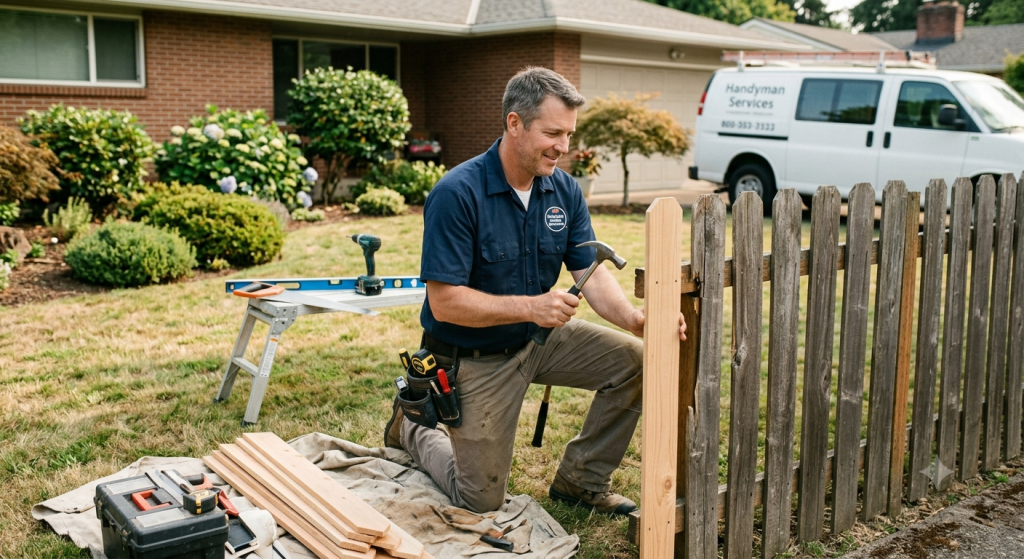
Real Fence Repair Costs in the GTA (2026 Pricing)
From a handyman’s perspective in Brampton and the Greater Toronto Area, most fence repairs fall somewhere between $150 and $2,500+, depending on the scope of work. Here’s what you can realistically expect to pay in 2026:
- Minor repairs (loose boards, replacing a few pickets, tightening hardware): $150–$400
- Replacing 1–3 fence posts: $300–$800 per post (including digging and concrete)
- Repairing a leaning fence section: $400–$1,200
- Replacing one damaged fence panel (6–8 ft section): $300–$900
- Gate repairs (adjustments, hinges, latches): $150–$500
- Gate replacement: $400–$1,500+
- Storm damage repairs: $500–$2,500+, depending on the number of sections affected
The biggest factors that affect price are:
- Post condition – Fence posts are usually the most expensive part of a repair. If posts are rotted, broken, or leaning, the job often requires digging out concrete and resetting new posts.
- Type of fencing – Wood fences are generally the most common and straightforward to repair. Vinyl, composite, ornamental metal, and specialty fences typically cost more due to material prices and sourcing.
- Extent of damage – Replacing a few boards is inexpensive; rebuilding multiple sections can approach the cost of a new fence.
- Access to the work area – Tight backyards, difficult terrain, or limited equipment access increase labour time and disposal costs.
- Material availability – Matching older fence styles, custom sizes, or discontinued materials can increase both labour and material costs.
- Concrete and digging requirements – Underground utilities, tree roots, rocks, or old concrete footings can significantly increase labour.
- Urgency and season – Emergency storm repairs, weekend service, and peak-season demand often result in higher pricing.
What drives costs down?
- Damage is limited to boards or rails rather than posts.
- Materials closely match what’s already installed.
- Multiple repairs can be completed during the same visit.
- Easy access and good ground conditions for digging.
As a rule of thumb, if more than 25–30% of the fence is damaged, I usually advise homeowners to compare the repair cost against partial or full replacement, since the long-term value may be better with new construction.
Two Real Fence Repair Case Studies from My Work
Case Study #1: Typical Fence Repair – Leaning Fence Section
A homeowner noticed that approximately 12 feet of their backyard wood fence was leaning toward a neighbour’s property after several seasons of freeze-thaw cycles. The fence boards and rails were still in decent condition, but two pressure-treated posts had rotted at ground level.
What I found:
- Two fence posts were failing below grade.
- The concrete footings had shifted slightly over time.
- The fence panels themselves were salvageable.
What I did:
- Removed the damaged posts and old concrete.
- Installed two new 4×4 pressure-treated posts.
- Re-secured the existing rails and fence boards.
- Realigned the fence section and ensured proper spacing.
Final Cost: Approximately $850 CAD (labour, materials, disposal, and new concrete included).
Outcome: The homeowner avoided replacing an entire fence run that would have cost several thousand dollars. The repaired section matched the existing fence and restored structural stability for many more years.
Case Study #2: Challenging Repair – Storm-Damaged Corner Fence
Following a major windstorm, a homeowner called because a corner section of their 6-foot wood privacy fence had collapsed. What initially appeared to be a simple repair turned into a more complex project.
What I found:
- Three fence sections were damaged.
- Four posts had snapped or shifted.
- A large tree root system ran directly beneath two of the failed posts.
- Several fence boards were split beyond repair.
What I did:
- Removed damaged fence sections and footings.
- Carefully worked around the tree roots to avoid damaging the tree.
- Relocated two posts slightly while maintaining fence alignment.
- Installed four new posts and rebuilt approximately 24 linear feet of fencing.
- Replaced damaged rails and boards and reinforced the corner section to better withstand future wind loads.
Final Cost: Approximately $2,400 CAD.
Outcome: The fence was fully restored without requiring removal of the mature tree. The homeowner gained a stronger corner assembly than the original construction, and the repair blended well with the remaining fence.
Key Takeaway: In my experience, the biggest difference between a lower-cost repair and a higher-cost one is usually whether the posts are still sound. Replacing a few boards may cost only a couple hundred dollars, but once multiple posts, concrete footings, difficult digging conditions, or storm damage are involved, costs can quickly move into the $1,000–$3,000+ range. A thorough inspection is often the best way to determine whether a repair or partial replacement offers the best value.
When to Repair vs. Replace Your Fence (My Professional Opinion)
From a handyman’s perspective, the decision usually comes down to the condition of the fence posts, the percentage of the fence that’s damaged, and the age of the fence.
When I Recommend Repairing
I generally recommend repairing when:
- The fence is less than 10–15 years old and structurally sound.
- Damage is limited to a few boards, rails, or one or two posts.
- Most of the fence is still straight and stable.
- The homeowner wants the most cost-effective solution.
- Replacement materials can reasonably match the existing fence.
For example, if a 100-foot fence has one leaning section and a handful of damaged boards, spending $500–$1,500 CAD on repairs usually makes far more sense than replacing the entire fence.
When I Recommend Replacing
I usually recommend replacement when:
- More than 25–30% of the fence requires repair.
- Multiple posts are rotted or leaning.
- The fence has widespread rot, insect damage, or warping.
- Previous repairs have already been done several times.
- The fence is approaching the end of its expected lifespan.
A common situation is a homeowner calling about a single leaning section, but after inspection we discover that six or seven posts are rotting at ground level. In those cases, repairing one section often becomes a temporary fix while other sections continue failing over the next couple of years.
Hidden Costs Homeowners Often Don’t Expect
- The posts look fine but aren’t. The biggest surprise is often underground rot. A post may appear solid above grade but be completely deteriorated where it enters the concrete.
- Matching old materials. Older fence styles, board dimensions, and stains can be difficult to match, making repairs more labour-intensive than expected.
- Tree roots and buried obstacles. Digging around roots, old footings, irrigation lines, or utility locates can add significant labour time.
- Multiple small repairs. Homeowners sometimes repair one section every year. Over time, those repair bills can exceed the cost of a properly planned replacement.
Common DIY Mistakes That Cost More Later
- Setting posts too shallow. Many DIY installations don’t dig below the frost line. In the GTA, shallow posts are a major reason fences lean after a few winters.
- Reusing failing posts. People often replace boards while leaving compromised posts in place. The fence may look better temporarily, but the structural problem remains.
- Incorrect concrete installation. Too little concrete, poor drainage, or improper post alignment can shorten the life of the repair.
- Using indoor or untreated lumber. I’ve seen repairs fail within a few years because the wrong materials were used to save money upfront.
- Ignoring the cause of the damage. If a fence failed because of drainage issues, poor post depth, or wind exposure, simply replacing damaged boards won’t prevent it from happening again.
Mistakes I Sometimes See From Inexperienced Contractors
- Quoting only for visible damage without checking the posts.
- Installing new fence sections onto aging existing posts.
- Skipping utility locates before digging.
- Using lower-grade materials than specified.
- Providing a low initial quote that grows significantly once work begins.
My Professional Rule of Thumb: If the repair cost is approaching 40–50% of the cost of a new fence, I usually encourage homeowners to seriously consider replacement. Spending $3,000 CAD to keep an aging fence alive for another two years is often less economical than investing $6,000–$8,000 CAD in a properly built fence that could last 15–20 years with maintenance. The best value isn’t always the cheapest repair today—it’s the option that gives the homeowner the lowest total cost over the next decade.
How Seasonality Affects Fence Repair Costs in the GTA
From a handyman’s perspective in Mississauga and the GTA, seasonality has a bigger impact on fence repairs than many homeowners realize. It affects not only pricing, but also how quickly repairs can be completed and how long they’ll last.
Winter (December–March)
Winter is usually the most challenging time for fence repairs.
What happens:
- Frozen ground makes post replacement difficult and more labour-intensive.
- Snow can hide damage or limit access to fence lines.
- Concrete work may require special cold-weather procedures.
- Emergency storm repairs are more common after high winds or heavy snow loads.
Impact on pricing:
- Simple repairs may cost about the same as other seasons.
- Post replacements and digging often cost more because of frozen ground and longer labour times.
- Emergency call-outs can carry premium rates.
My advice: If the fence is safe and not at risk of collapsing, temporary stabilization through winter and a permanent repair in spring is often the most cost-effective approach.
Spring (March–May)
Spring is when many fence problems become visible.
What happens:
- Frost heave and thawing soil reveal leaning or shifted posts.
- Homeowners discover damage that occurred during winter.
- Contractors start receiving a large volume of repair requests.
Impact on pricing:
- Material costs are generally stable.
- Demand begins increasing, which can extend scheduling times.
- Early spring is often a good balance between availability and weather.
My advice: Spring is one of the best times to schedule repairs. Catching post movement early can prevent additional sections from failing during summer storms.
Summer (June–August)
Summer is peak season for fence work throughout the GTA.
What happens:
- Ideal weather conditions for repairs and installations.
- Many homeowners prepare yards for entertaining or landscaping projects.
- Contractors are often booked weeks in advance.
Impact on pricing:
- Labour rates may be higher due to strong demand.
- Lead times are usually the longest.
- Material suppliers can occasionally experience shortages during busy periods.
My advice: Summer provides excellent installation conditions, but homeowners should schedule early. Waiting until mid-summer often means paying peak-season rates and facing longer wait times.
Fall (September–November)
Fall is often my favourite season for fence repairs.
What happens:
- Cooler temperatures make outdoor work easier.
- Ground conditions are usually stable.
- Contractor schedules often become more flexible after the summer rush.
Impact on pricing:
- Pricing is generally competitive.
- Availability is often better than summer.
- Repairs completed in fall are ready to withstand winter conditions.
My advice: If the fence isn’t an emergency, fall is frequently the best value. You can often secure better scheduling flexibility and address problems before snow and frost arrive.
Best and Worst Times to Schedule Fence Repairs
Best times:
- Early Fall (September–October) – good weather, better availability, and preparation for winter.
- Spring (April–May) – ideal for correcting winter damage before it worsens.
- Early Summer (June) – excellent conditions if booked in advance.
Worst times:
- Mid-Winter – frozen ground, weather delays, and higher labour costs for post work.
- Peak Summer (July–August) – highest demand and longest wait times.
- After Major Storm Events – repair demand spikes, and emergency pricing may apply.
One Common Mistake Homeowners Make: A lot of homeowners notice a leaning post in spring and decide to “watch it for another year.” By the following spring, that one failing post has often pulled rails loose, twisted adjacent sections, and turned a $500–$1,000 repair into a $2,000+ project. My recommendation is simple: repair structural issues as soon as they’re discovered, but plan non-urgent repairs for spring or fall whenever possible. Those seasons usually offer the best combination of pricing, scheduling flexibility, and long-term repair quality in the GTA.
My #1 Pro Tip: Don’t Focus on the Boards—Focus on the Posts
From a handyman’s perspective, the one piece of advice I give homeowners most often is: “Don’t focus on the boards—focus on the posts.”
Most homeowners look at a fence and judge its condition by what they can see: cracked boards, peeling stain, or a section that’s leaning. But the real health of a fence is almost always determined by what’s happening at the posts, especially at ground level and below grade. I’ve seen homeowners spend hundreds or even thousands of dollars replacing boards, painting, staining, or reinforcing rails, only to discover a year later that the posts were already failing. The fence looked great temporarily, but the structure underneath was still deteriorating.
The Pro Tip
At least once a year, walk your fence line and check every post:
- Push on it firmly in multiple directions.
- Look for movement at ground level.
- Check for cracks, rot, or soil pulling away from the base.
- Pay special attention to corners, gates, and sections exposed to strong winds.
If you catch a failing post early, you might spend $300–$800 CAD on a targeted repair. If you wait until multiple sections start leaning or collapsing, that same issue can easily turn into a $2,000–$5,000+ CAD project.
Something Most People Don’t Think About
A fence rarely fails all at once. It usually gives warnings for months or even years:
- A gate stops closing properly.
- One section develops a slight lean.
- A post moves a little during a windstorm.
- A few nails or screws start popping out.
Those aren’t cosmetic issues, they’re often early indicators of structural movement.
My Personal Philosophy
I tell homeowners to think of fence maintenance like roof maintenance: You don’t wait for water to pour through the ceiling before fixing a roof, and you shouldn’t wait for a fence to fall over before fixing a post. The cheapest fence repair is almost always the one done before the damage becomes obvious.
The Peace-of-Mind Factor
A well-maintained fence isn’t just about appearance. It protects privacy, keeps children and pets secure, helps avoid disputes with neighbours, and prevents emergency repair bills after storms. If I could give homeowners only one takeaway, it would be this: Inspect your fence posts, not just your fence boards. Most expensive fence repairs start as small post problems that were easy and inexpensive to fix months earlier. That simple habit catches more costly problems than any stain, sealant, or annual maintenance routine ever will.
Final Thoughts: Get an Honest Assessment Before You Spend
Fence repair costs in 2026 aren’t one-size-fits-all, they depend on your fence’s age, material, damage type, and even the time of year. But whether you’re facing a $200 board replacement or a $2,500 storm rebuild, the smartest move is always the same: get a thorough, honest assessment of what’s really going on, especially below ground.
If you’re in Brampton or the GTA and want a no-pressure, experience-based opinion on whether your fence needs repair or replacement, feel free to reach out. I’d rather help you avoid a costly mistake than sell you a quick fix that won’t last.